

Learning Experience "Keep Quiet or Snitch"
A Serious Game for Understanding the Phenomenon of "Trust"
Author: Marco Lardelli
License
CC BY-SA 4.0
This document © 2026 "Trägerverein Know2" is licensed under the "Creative Commons Attribution-ShareAlike 4.0 International" license.
For a copy of the license, visit https://creativecommons.org/licenses/by-sa/4.0/
Project website: https://know-know.org
EXPERIMENTAL / ALPHA
This game is in an early development phase and is intended for testing by our community. Feedback is warmly welcomed – whether in the form of experiences, suggestions for improvement, or ideas.
1. Objectives
"Keep Quiet or Snitch" playfully conveys important (because socially especially relevant) concepts from game theory. The game is essentially an implementation of the classic "Prisoner's Dilemma" thought experiment as a card game for two players.
Theoretical explanations, however, are not necessary (but optionally possible - for older students and adults).
The game is repeated under various conditions:
- Only one repetition of the game (classic prisoner's dilemma)
- The game is played multiple times in a row (iterated prisoner's dilemma), whereby the number of repetitions is always unknown.
- The game is played multiple times in a row (iterated prisoner's dilemma), whereby the number of repetitions is always the same and known.
What is interesting here is that the optimal strategies differ greatly in these three cases.
The social significance of the three game variants is explained at the very end.
2. Preparations Base Game
- The cards are distributed to the two players as follows:
(see following page)
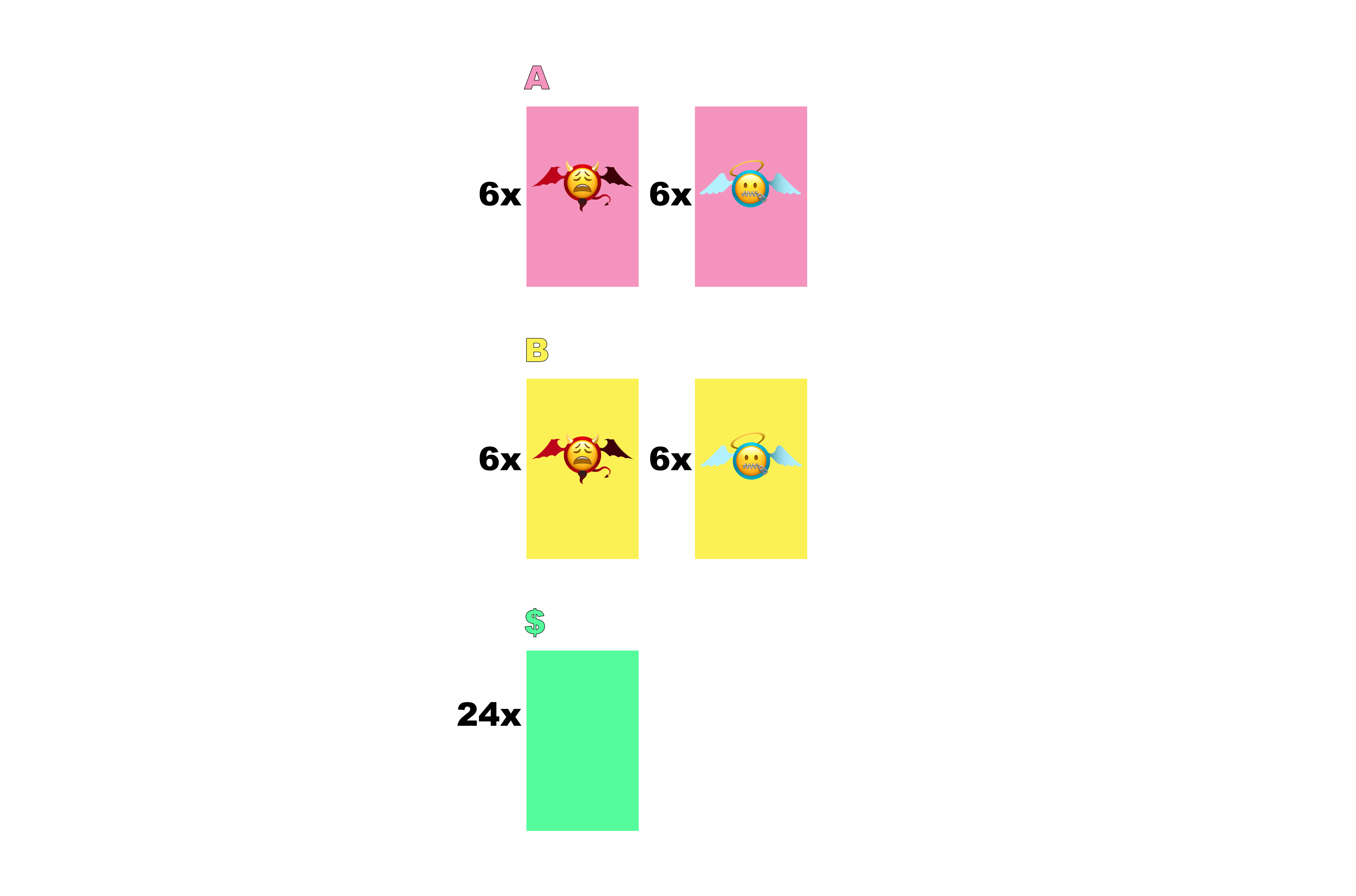
- The two variants of a player's playing cards ("Snitching" and "Keeping Quiet") are shuffled.
- The money is placed on a shared pile.
- Each player holds their playing cards in front of them so that the other player cannot see them.
3. Course of the Base Game
- Both players simultaneously place a playing card of their color face down on the table.
- Now both cards are revealed and the number of points each player receives is determined according to the following table:
(see table on the following page)
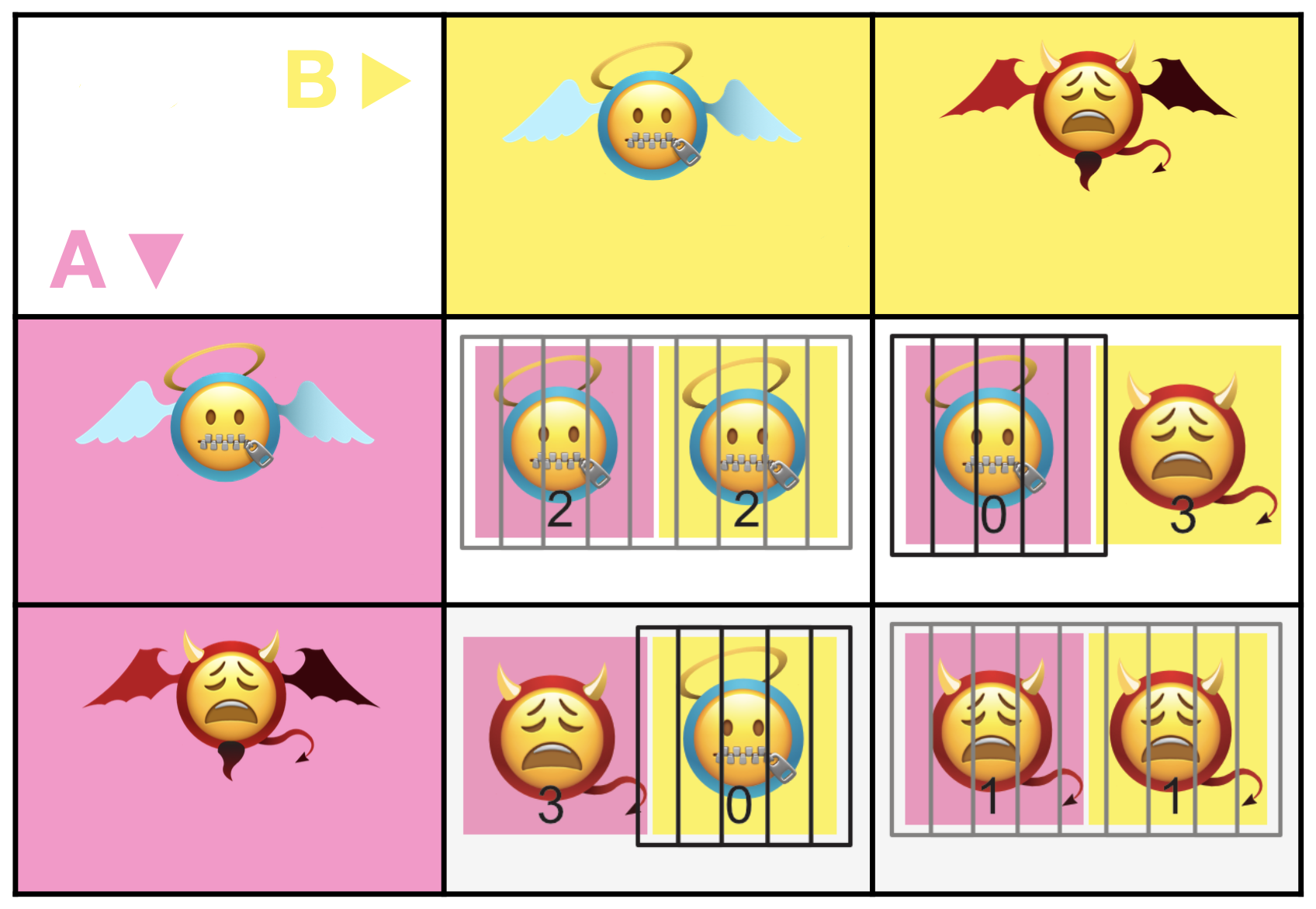
- Each player receives money cards (or tokens) according to the determined number of points.
- Steps 1-3 are repeated over one or more rounds, depending on the game variant.
- The Gamemaster stops the game after a certain number of rounds (arbitrary and without prior announcement or after a fixed and previously announced number. See below).
- Each player keeps a record (note sheet) of the number of points they have won.
- Whoever has the most money at the end of the round has won the round.
The players may not communicate (i.e. they must remain silent during the game and may also not use any signs)
4. Game Variants
The game is played over multiple rounds in each case. The following variants are possible:
- Variant A: Two players always play only a single round against each other (i.e. the composition of the player pairs is changed after each round).
- Variant B: The same players play several rounds (4, 5, or 6. See above) against each other, whereby the number of rounds is unknown.
- Variant C: The same players play several rounds (e.g. 3 or 4) against each other, whereby the number of rounds was announced beforehand.
5. Typical Observations
In Variant A, snitching (i.e. non-cooperative behavior) is always more promising: Regardless of the decision the opponent makes, snitching brings more points in every case. This is interesting, since it naturally always leads to the situation in which both players snitch. But if both were to keep quiet, both could benefit. However, this requires trust, which cannot arise in a one-time interaction. Cooperative behavior therefore only makes sense in repeated interaction. In interactions that only take place once, non-cooperative behavior is always more advantageous for the individual.
In Variant B, cooperative behavior can emerge. Players who enter the game with cooperative behavior are often more successful. Trust can only arise through repeated interaction. However, it is also important to immediately respond to non-cooperative behavior of the opponent with corresponding behavior of one's own. Then, of course, trust collapses (forever or at least for a certain period of time).
In Variant C, it makes sense to snitch at least in the last round. If the opponent does this, however, it is better to snitch already one round earlier. This then ultimately leads to trust completely collapsing right from the start and it always being more advantageous to snitch.
6. Social Significance
VARIANT A
Interactions that only take place once are typical of the Internet. Correspondingly, one often observes non-cooperative behavior. Examples are SPAM emails, fraudulent online shops that do not deliver goods, etc. The Internet enables "fishing" in a huge "ocean" of customers, so that repeated interactions are not even necessary (i.e. one can also get rich by interacting - fraudulently - only once with a very large number of customers). Many Internet platforms try to counteract this mechanism with rating systems (e.g. rating buyers/sellers on Ebay). Another way to create trust with potential business partners even for one-time transactions are well-known (and thus valuable) brands.
VARIANT B
Here, in the ideal case, a cooperative situation can arise over a longer period of time, from which both players benefit. However, this requires trust. This often arises among friends and family as well as in long-term customer relationships in business.
VARIANT C
This case is interesting because it shows how a seemingly insignificant simplification of the game situation makes cooperative behavior completely impossible. This can also often be observed on the Internet. Since interactions on the Internet are typically highly structured (so that they can be processed by computers), correspondingly very simple game-theoretical situations arise. This enables people to determine the possible behaviors of the interaction partners and then to "calculate" their own optimal behavior. That is, such simple situations therefore make the players' behavior predictable. This then naturally leads to everyone starting to "calculate" and consequently the - in a certain sense "irrational" - trust can hardly be maintained.
7. Recommendations for Experiments
Sometimes small, supposedly irrelevant changes to the game lead to dramatically altered strategies.
Experiment with such variants and observe how the game changes.
Examples:
- What changes if players are allowed to talk to each other?
- What changes if you do not know which player you are playing against?